
- Home
- Cephalometric analysis
Free plan, no sign-up needed to try
Cephalometric analysis in your browser
Simplified Ceph lets you trace a lateral cephalogram on screen and read the classic analyses as you go. Every value is shown next to its norm. Print the report or save it as a PDF.
- Images stay on your device
- Works offline
- Phone, tablet or computer
What it does
You place the landmarks. The tool does the arithmetic, compares each reading with its norm and builds the report.
Analyses included
Ten analyses, on the lateral and frontal (PA) cephalogram.
Steiner
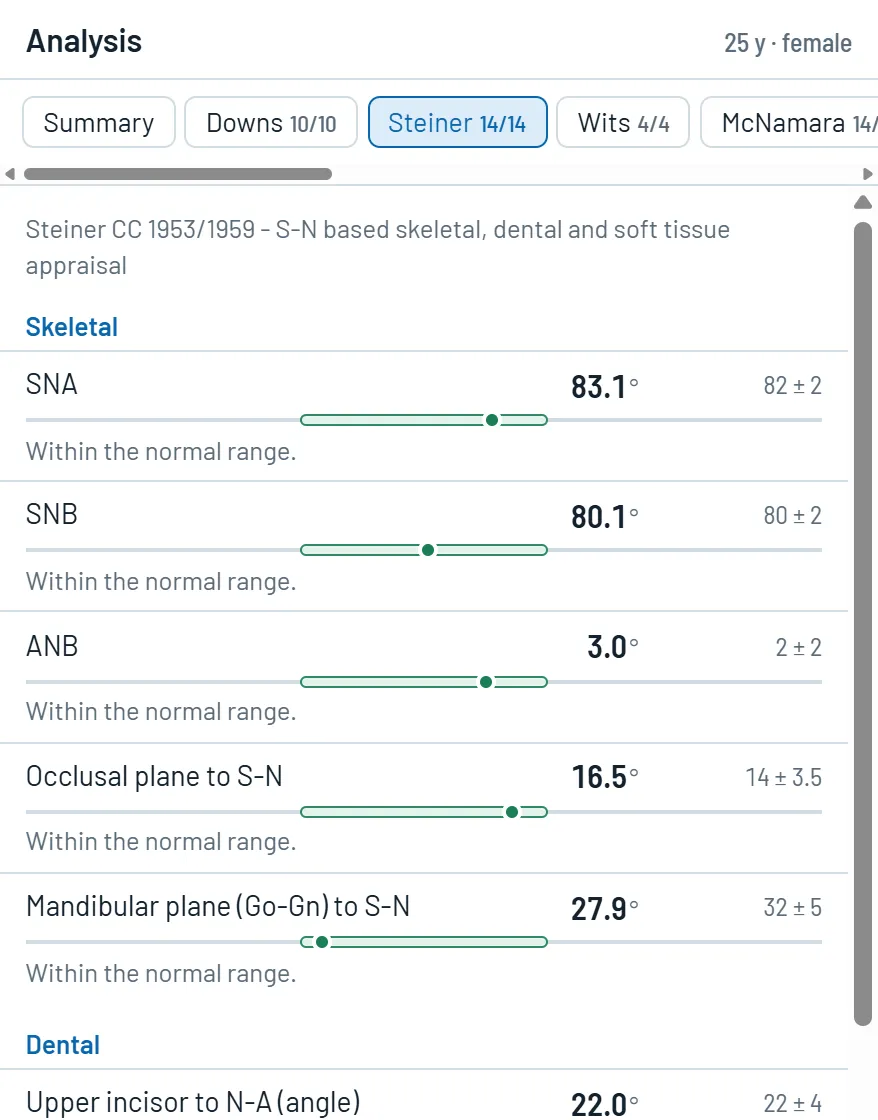
Skeletal, dental and soft tissue readings on the S-N line: SNA, SNB, ANB, incisor angles and distances.
Downs
Skeletal and dental pattern on the Frankfort horizontal, including the facial angle and the Y-axis.
Ricketts
The lateral summary and comprehensive analysis on Frankfort and the pterygoid vertical, with norms adjusted for age where they are defined.
McNamara
Nasion perpendicular, effective jaw lengths, and the upper and lower pharynx.
Tweed-Merrifield
The Tweed facial triangle (FMA, IMPA, FMIA) and Merrifield's analysis.
Wits
The AO-BO distance on the functional occlusal plane.
Holdaway
Soft tissue analysis on the H-line.
Soft tissue profile
Profile proportions, nose, lips and chin, after Jacobson and Vlachos.
Proportions and divergence
Anterior and posterior facial heights and the divergence of the facial planes.
Ricketts frontal Plus and Pro
The frontal (PA) analysis: widths, symmetry and the midline.
Norms follow the published values for each analysis, as collected in Jacobson's Radiographic Cephalometry (2nd edition). Most norms come from specific study groups, so read them with your patient's age, sex and ethnic background in mind.
See it in use
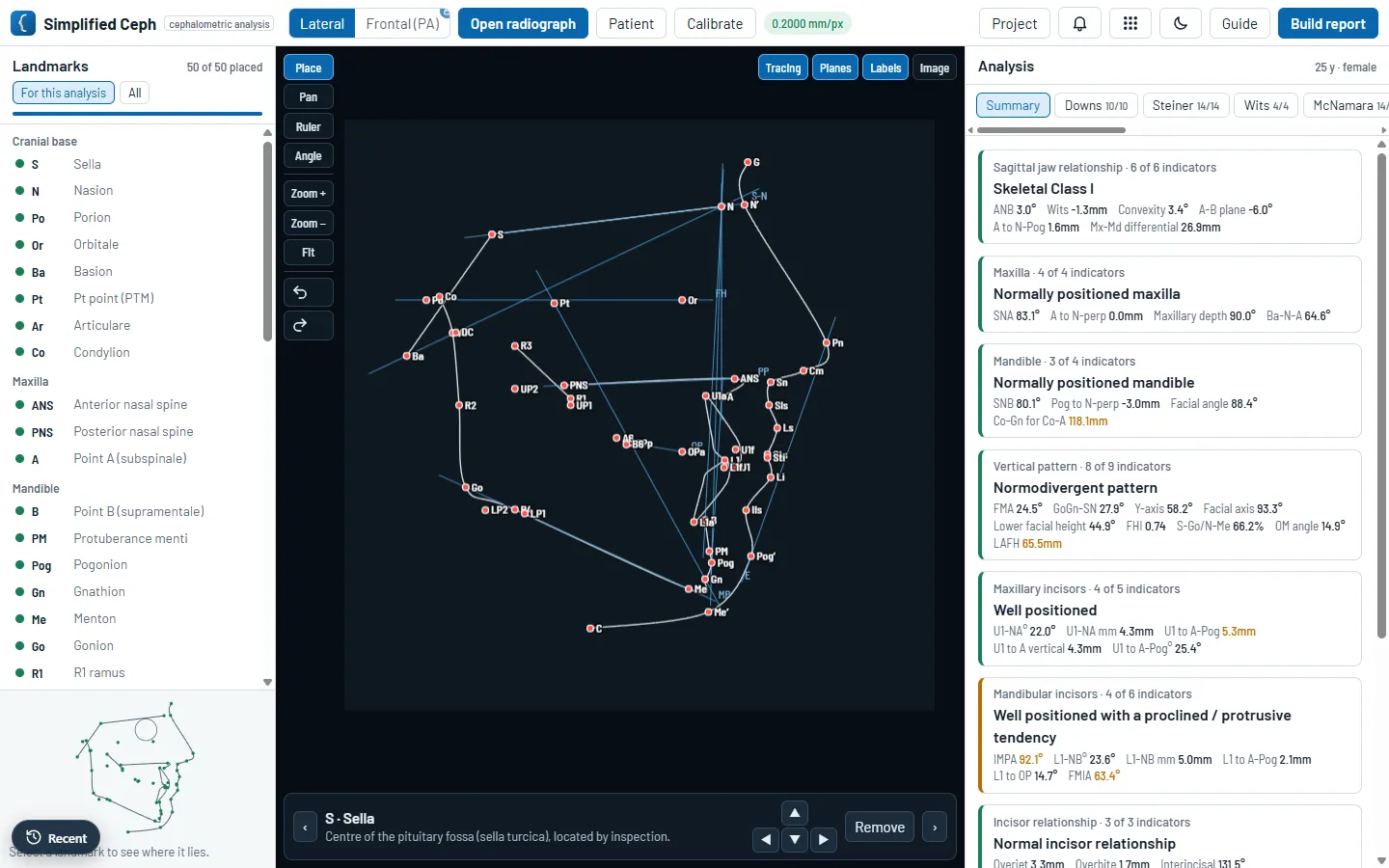
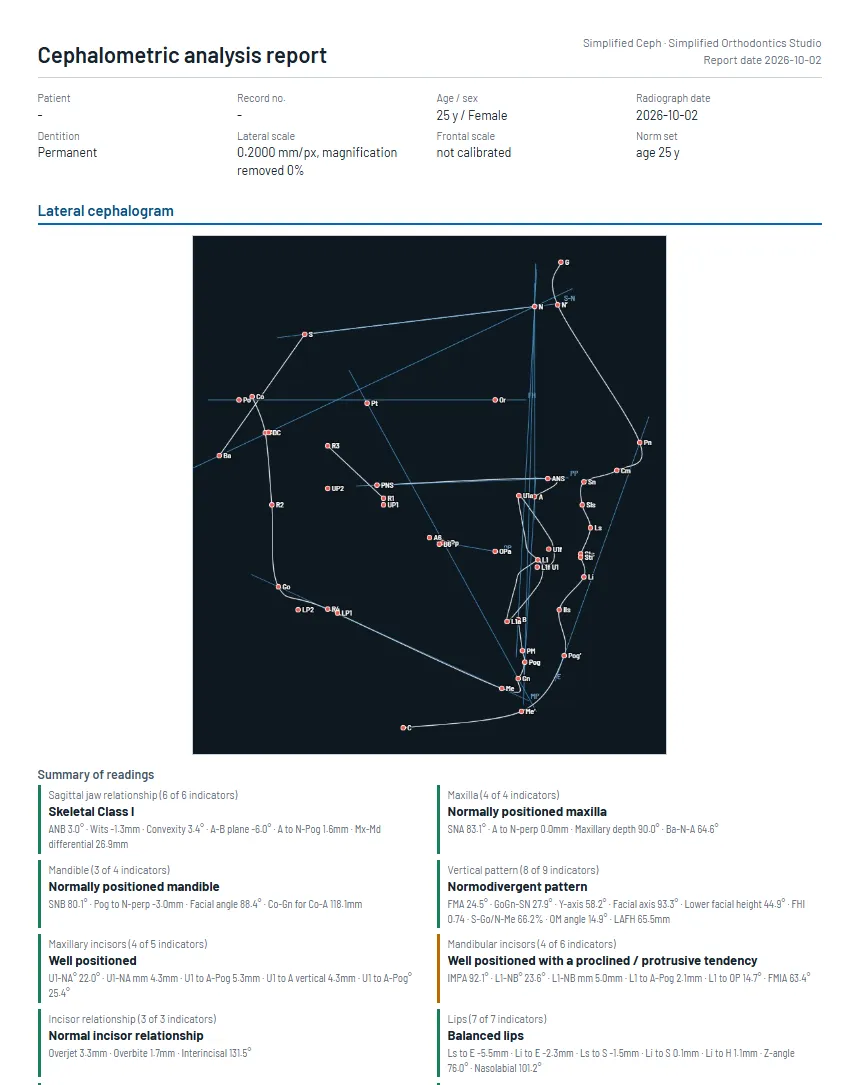
Screenshots of the built-in sample tracing. It is a drawn example, not a real patient.
How it works
From the radiograph to the report in five steps.
- Open the radiographA JPG, PNG, BMP or WebP image of a lateral headfilm.
- CalibrateMark two points a known distance apart on the film ruler, or type the scale.
- Pick an analysisSteiner, Ricketts, McNamara or any other. The list shows the points it needs.
- Place the landmarksClick or tap each point. The readings update as you go.
- Build the reportPrint it, save it as a PDF, or save the case to reopen later.
Questions
Is Simplified Ceph free?
Yes, there is a Free plan for lateral cephalometric analysis. Plus and Pro add more new cases a month and the frontal (PA) analysis. The sample tracing never counts as a case. See the plans.
Do I need to install anything?
No. It opens in the browser on a phone, tablet or computer. You can also install it like an app, and after the first visit it works offline.
Is my radiograph uploaded?
The radiograph opens and is traced in your browser, and your work is saved on your device first. If you sign in, the cases you save are also copied to your private Studio cloud, so they open on your other devices. Privacy policy.
Which image files can I open?
JPG, PNG, BMP and WebP. If your radiograph is a DICOM file, export it as an image first.
Can I try it without a radiograph?
Yes. Open Simplified Ceph and choose Load a sample tracing. Drag any landmark and watch the analyses change.
What is Simplified Ceph for?
Analysis, education and research. It measures what you trace and compares it with published norms. The readings support your clinical judgment and do not replace it. It is not a medical device.
The other tools in the Studio
One studio, five tools. Each one opens in the browser, works offline and has a free plan.
Try it on the sample tracing.
Open Simplified Ceph, load the sample and drag a landmark. No sign-up needed.